
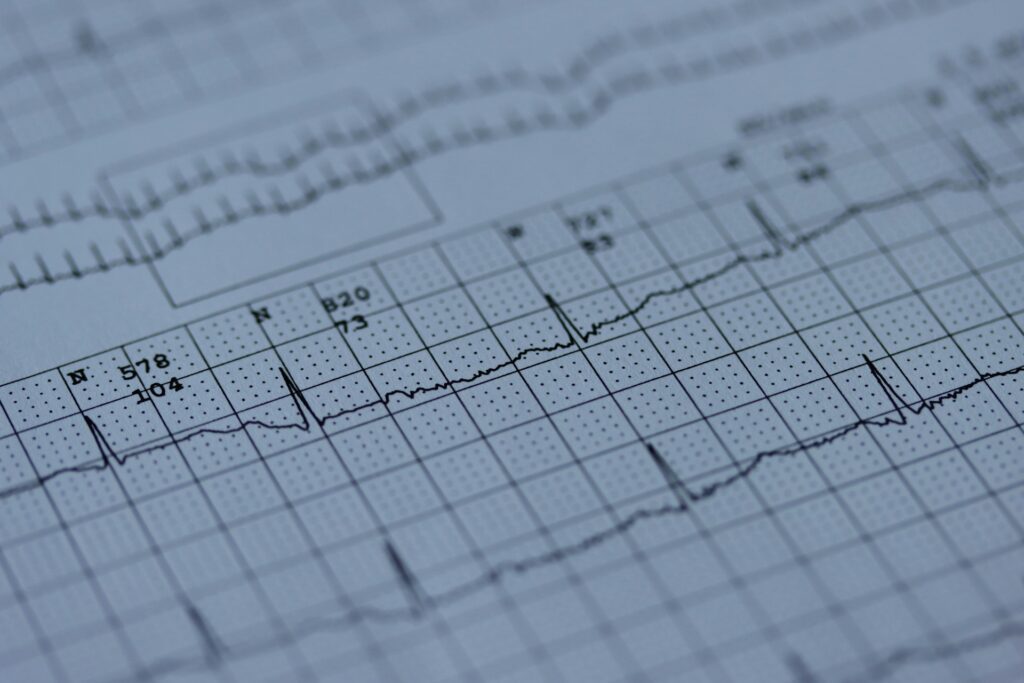
You’re in your GP’s waiting room. Your doctor wants you to have an ECG. You touch your chest and tell yourself it’ll be fine. But what is this test, and what will it show?
This guide explains what an ECG is, why doctors order one and how they read it. If you already had a result that says “abnormal”? Read what an abnormal ECG result means instead. To understand what might cause an abnormal ECG, read Why Is My ECG Abnormal? 10 Surprising Causes.
Understanding ECG basics
Ever wondered how doctors can “listen” to your heart without actually pressing a stethoscope to your chest? That’s where an ECG comes in.
An electrocardiogram (ECG) is simply a snapshot of your heart’s electrical activity – nothing scary about it. The test is painless, quick and can reveal crucial information about how your heart is functioning.
How does an electrocardiogram (ECG) work?
Your heart is a muscle that contracts and relaxes, and these movements are controlled by electrical signals. Essentially, your heart is having its own built-in electrical system – when this system fires, your heart contracts and pumps blood. The ECG is the electrical representation of the contractions and produces a series of waves.
The key components of an ECG reading
When you look at an ECG, you’ll see a sequence of waves that look like peaks and valleys. Each part has a name and tells a different story about the heart. Doctors analyse these patterns like detectives looking for clues. The height, width and spacing between these waves can reveal if your heart is beating too fast, too slow or irregularly, or if the compartments in your heart are contracting in order.
Why doctors order ECG tests
Doctors don’t just order ECGs for fun. They’re looking for specific information to ensure that your heart is functioning correctly. An ECG can detect problems you might not even feel yet, which is why it’s such a powerful tool.
Common reasons include:
- Chest pain or discomfort that might signal a heart attack
- Symptoms like shortness of breath, dizziness, or fainting
- Checking how well heart medications are working
- Monitoring known heart conditions
- Pre-surgery screening to make sure your heart is strong enough
- Part of a routine physical for people with risk factors like high blood pressure
Interpreting ECG results
How doctors analyse ECG patterns
Doctors start by checking the heart rate – is it too fast, too slow or just right? Next, they look at the rhythm – is your heart beating in a steady pattern, or is it doing its own chaotic dance?
The real detective work begins when they analyse each wave (peaks and valleys) on the graph. Changes in the size, shape or timing of these waves can signal specific problems.
They’ll also check the electrical axis (basically the direction of the heart’s electrical flow) and look for any signs of chamber enlargement or muscle damage.
What does normal ECG reading look like
A normal ECG has a pretty specific pattern that doctors recognise immediately. For a healthy heart, the peaks and valleys on a graph that represent one beat cycle are the same shape and are separated by the same distance.
Normal doesn’t mean identical for everyone, though. Your age, gender, body size, and even the position of your heart in your chest can affect how your ECG looks while still being perfectly normal.
What matters most is how your current ECG compares to what’s expected for someone like you, or how it’s changed from your previous tests.
When an ECG isn’t ‘normal’
If the waves differ from the usual pattern, the report may say “abnormal” or “borderline.” That word covers a lot. Some findings are harmless variations seen in healthy people. Others need a closer look.
Many findings are like a small scratch on your car. Worth noting, but no reason to panic.
Your doctor will tell you which kind you have. If your result has already come back abnormal, our guide to what an abnormal ECG result means walks you through it.
Other heart tests your doctor may order
An ECG is often the first heart test you’ll have. If it doesn’t give the full picture, your doctor might order one of these:
- Blood tests to look at biomarkers in your blood.
- Echocardiogram – uses sound waves to create moving pictures of your heart’s structure and function. Similar to a pre-natal scan of a baby.
- Stress test – sees how your heart performs during exercise, when problems often become more obvious.
- Holter monitoring – like wearing a portable ECG for 24-48 hours to catch intermittent issues.
- Cardiac MRI or CT – provides detailed 3D images to spot structural problems or coronary disease.
Waiting for these tests on the NHS can take weeks or months. Our guide to bypassing cardiology waiting lists explains your options.
When the recording itself goes wrong
ECGs aren’t foolproof. They’re snapshots in time – like trying to judge a movie from a single frame.
Sometimes the problem is the recording, not your heart. A loose sticker, movement, shivering or tense muscles can all add noise to the trace. Nerves make tense muscles more likely. That noise can look like a heart problem on paper. Doctors call it an artefact.
Questions to ask about your ECG results
Whatever your result, you have the right to understand it. Write your questions down before your appointment.
Here are some to start with:
- “What exactly does my ECG tell you about my heart?” Get them to explain in plain English
- “Is this something that needs immediate attention or can we monitor it?”
- “Should I see a cardiologist for a second opinion?”
- “Do we need to run additional tests to confirm what’s going on?”
- “How reliable is this test result? Could there be false positives?”
- “Does this ECG trace explain any symptoms I’ve been having?”
Take notes during this conversation. Doctors throw around terms like “ST elevation” or “bundle branch block” that might sound like a foreign language. Ask them to draw pictures if needed – visual explanations help a ton.
When a 10-second ECG isn’t enough
A standard ECG records your heart for about 10 seconds. Some heart problems come and go, so they can hide in that short window. They’re like a strange car noise that stops the moment you reach the mechanic.
If you have palpitations, dizziness or fainting that come and go, your doctor may suggest a Holter monitor. It’s a small, portable ECG you wear at home for one or more days. Rhythm problems like SVT are often caught this way.
You don’t have to wait for a referral to get one. Your Heart Check sends a 3-day Holter monitor to your door. And you get a report to share with your doctor.
Perhaps your smartwatch has an ECG feature. Read our comparison of smartwatch ECGs and Holter monitors to check if your smartwatch is enough.
The bottom line
An ECG is a quick, simple way to see how your heart’s electrical system is working. It can show rhythm problems, signs of strain and damage from a past heart attack. But it’s one snapshot. Your symptoms, history and other tests matter too.
Want to know more about checking your heart rhythm at home? Get in touch or see how our heart monitoring works.
As always, let’s stay heart-happy.