You come home, shoes off, coat on a hook, kettle on – finally. It’s been a long day, but whilst you sit down with a cup of tea, trying to relax… your heart decides to do this thing again.
Skipping and fluttering, making it very clear this is out of the ordinary.
You can’t ignore it – of course not – it’s your heart!
But since it only lasted a short while, you decide that a visit to a GP and starting a ‘formal investigation’ is not needed. Though a check of sorts is, nonetheless.
This is 2026; advanced technology is everywhere, including on your wrist. Surely, there must be a way to use your smartwatch and perhaps other at-home tests to check your heart health.
You are right, indeed.
In this article, we will take you through ways to check your heart health at home:
- The type of checks your smartwatch can do,
- When a medical-grade Holter is a good idea,
If you’re curious about what other tests you can do from the comfort of your sofa, we cover that in our article on how to check your heart health at home.
The short version – if you only have time to read one more sentence – track your heart rate day-to-day with a smartwatch, use its ECG feature as a casual spot-check when something feels off, and use a Holter monitor if symptoms keep happening and a quick check can’t explain them.
So, have your cup of tea at the ready, and let’s begin.
What Your Smartwatch ECG Is Good For (and Where It Stops)
Hearing the term ECG is likely giving you images of a doctor’s office, lying down with electrodes attached on one end to your chest and on the other to a machine that continuously prints out a series of ‘squiggles’, so the idea of your smartwatch performing the same test, but minus the awkwardness of an ECG test, is very tempting.
Can your smartwatch do a reliable ECG test? Let’s find out.
How to Check Heart Health With a Smartwatch ECG
A smartwatch ECG works by detecting the tiny electrical signals your heart produces with every beat. When you place your finger on the watch’s crown or sensor, you complete a circuit between your wrist and your fingertip, and the watch measures the difference in electrical activity between those two points, giving it a single “lead” on your heart’s electrical pattern. In comparison, an ECG done at the doctor’s office is a 12-lead ECG.
The watch takes about 30 seconds to perform the test, after which it gives you a result: most commonly “sinus rhythm,” meaning your heart appears to be beating in a normal, regular pattern, or “possible atrial fibrillation,” flagging the chaotic, irregular rhythm that is the hallmark of AF.
It is worth understanding, though, that this single-lead, 30-second screen gives the watch a fairly narrow window onto your heart’s electrical activity. And it can only “detect” what it has been trained on, and most smartwatches have been trained on the most common rhythm disorder, AF.
Everyday Scenarios Where a Watch Helps
Unlike heart rate, a smartwatch doesn’t continuously monitor ECG. You don’t get a graph showing your heart rhythm throughout the day or whilst you were sleeping. You need to ‘ask it’ to take the reading, and the recording will only be 30 seconds long.
Here are a few ways to get the most out of the ECG feature on your smartphone when you’re trying to check your heart rhythm at home:
- Set a routine. Let’s assume you are over 40, and you want to check your heart health at home purely for peace of mind. Create a daily routine of running an ECG on your smartwatch and recording your findings in a journal or notebook to monitor trends over the weeks.
- You’ve experienced a heart symptom – a fluttering in your chest for a few minutes, for example. Take a watch ECG, note the time, symptoms, and triggers, and anything else your doctor is likely to ask about.
- You are making changes to your lifestyle. For example, you are starting a new exercise program or a hobby. Use the ECG function on your watch to check whether your body – especially your heart – is adapting to the new regime.
There are a couple of other aspects you should consider, especially if you have a pacemaker. We discuss this in the article you can find by clicking here.
When Your Watch Makes You Anxious: How Often to Check and When to Call
Beyond on-demand ECG readings, most smartwatches also run continuous background monitoring that can flag irregular rhythms without you having to do anything at all.
If the watch’s optical sensor detects a pattern consistent with AF over several checks, it will send a notification prompting you to take a manual ECG to investigate further and may also suggest contacting a doctor if the irregularity persists.
These notifications are a useful reassurance and a safety net, but they come with real limitations on accuracy.
What Smartwatch ECGs Can’t Tell You
In short: a smartwatch ECG is mainly built to flag one specific problem — atrial fibrillation. It can miss other arrhythmias entirely, and movement, poor skin contact, or even tattoos can trigger false alarms.
The question you might be asking yourself right now is whether a smartwatch ECG is accurate for checking heart health.
The short answer is – not exactly.
The smartwatch relies on an optical sensor to detect your heart rhythm. Movement, poor wrist contact, low signal quality, or even tattoos can, therefore, produce a reading that looks irregular when the heart is actually fine – a false positive.
The reverse is also true: a brief or intermittent arrhythmia can easily be missed if it does not happen to occur during the handful of seconds you are taking a reading, leading to a false negative.
Most importantly, though, smartwatches are generally poor at distinguishing AF from other, more benign causes of irregularity, such as ectopic beats or sinus arrhythmia, which can trigger an alert even though no real problem exists.
Remember, AF is only ONE type of arrhythmia. There are other, less common, rhythm disorders that smartwatches are not ‘trained’ on and therefore can’t detect.
For this reason, treat an ECG or irregular rhythm notification from a smartwatch with a grain of salt. Apple or any other smartwatch’s ECG is not enough to check your heart health. Apple itself points out that the smartwatch is not a diagnostic device and advises that it should not be used to diagnose or guide treatment of heart conditions.
To properly diagnose a problem with your heart’s rhythm, you need a clinical-grade device (an important term to keep in mind). The good news is, you can order one of these too and check your heart health at home.
What a Holter Monitor Is (In Real Life)
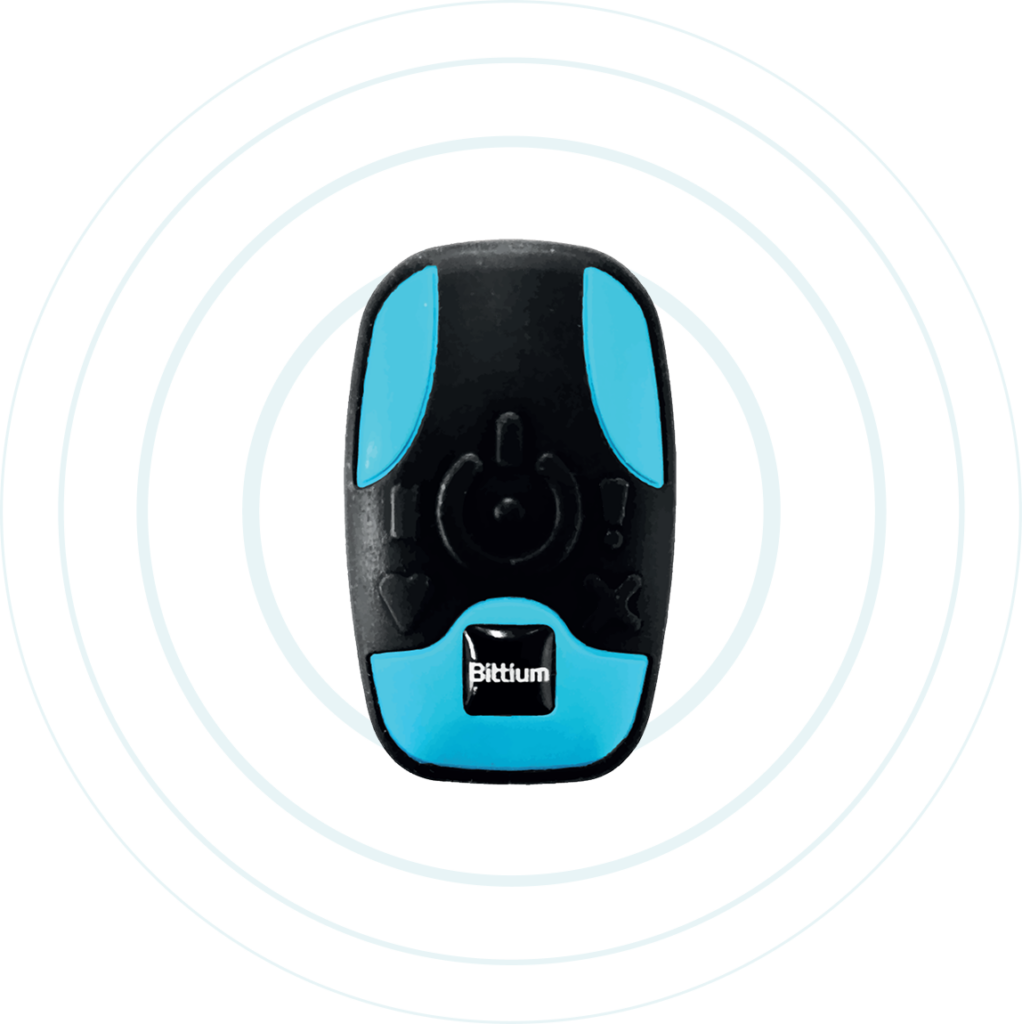
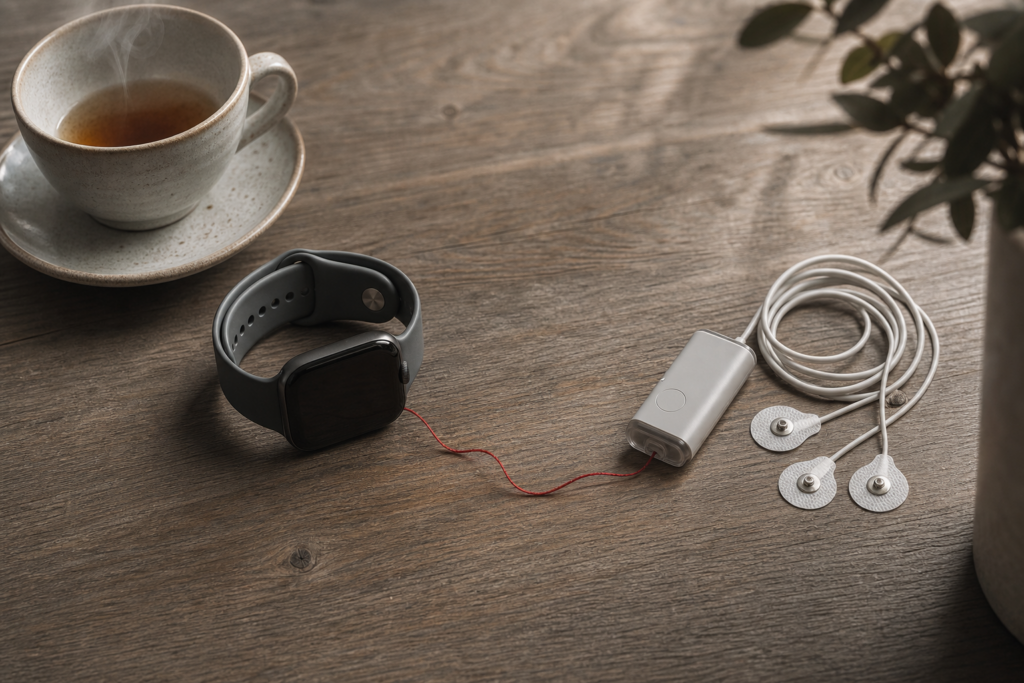
In plain English, a Holter monitor is a small, portable ECG device that you wear continuously. Usually, a Holter is clipped to your belt or worn over your shoulder, with a few sticky patches on your chest connected to it by wires.
Sounds very medieval, we agree, but don’t worry. These days, you can order a Holter as small as a USB stick, so small in fact, you can barely notice it under your clothes, and you can hardly feel it on your body while wearing it.
Unlike a standard ECG in a doctor’s office, a Holter monitor records your heart’s electrical activity continuously for 24 to 72 hours, even a week if you wanted to, while you go about your normal day – working, exercising, sleeping, and so on.
We admit, a Holter puts a few temporary limitations on your daily routine. For example, with modern Holters, you can still shower, but you might have to pause bathing, swimming, diving, or sauna visits.
Nonetheless, these drawbacks are easily outshone by the benefits of wearing a Holter. Unlike a smartwatch, this heart rhythm monitor is not ‘trained’ on any particular arrhythmia. All it does is record every beat of your heart that is then analysed by an electrophysiologist.
For you, this means a few things:
- Those strange flutters that come and go at random? Recorded.
- Your heart rate spiking out of the blue? Recorded.
- That sensation like your heart is doing backflips? Recorded.
- The moment when you felt lightheaded? Recorded.
- The afternoon when you weren’t sure if it’s anxiety kicking in or your heart having one of those moments? Also recorded.
- Every strange moment that you might have labelled ‘that’s just what my heart does’? Recorded.
In other words, your heart can’t hide from the Holter.
In short: a Holter monitor records every heartbeat for 24 hours to a week, so it can catch irregular rhythms a smartwatch would miss — especially ones that are brief, random, or happen while you sleep.
Holter vs Smartwatch ECG: What Each Is Actually For
At this point, you might be wondering how the two devices actually compare when it comes to monitoring your heart health at home.
While both a smartwatch and a Holter monitor can pick up on irregular heart rhythms, they’re built for fairly different jobs. One is designed for quick, casual spot-checks whenever you want, and the other for sustained, continuous tracking.
The table below breaks down how they stack up across the things that matter most: what each is good at, what it can miss, how long it monitors for, what it’s actually like to wear or use, and who tends to reach for one.
| Smartwatch | Holter monitor | |
|---|---|---|
What it’s best at | On-demand AFib screening; spot-checking for irregular heartbeat at a single point in time | Continuous heart rhythm monitoring, tracking your heart’s electrical activity around the clock |
| What it misses | Other arrhythmias and rhythm disorders beyond AFib, since it only screens for one specific condition | Arrhythmias that occur very infrequently and may not happen during the monitoring window |
| How long it monitors | A single 30-second on-demand ECG reading | Continuous ECG recording, anywhere from 24 hours up to 7 days |
| What it feels like to use | You pause your day to take a manual reading whenever you want a heart rhythm check | Depending on the device, you wear a small box or patch-style monitor (some as compact as a USB stick) throughout your daily activities |
| Who usually gest one | Anyone interested in casual, at-home heart health monitoring | Typically prescribed for anyone whose doctor wants a closer look at their heart rhythm over time, but can also be ordered by anyone who wants to check heart health at home |
Use this at-a-glance comparison whenever you’re checking your heart health at home and deciding which tool actually fits your situation.
Do You Really Need a Holter If Your Smartwatch ECG Is Normal?
In short: a smartwatch is the smoke alarm — it tells you something might be worth a closer look. A Holter monitor is the fire investigator — it tells you what’s actually going on.
So, back to that fluttering feeling in your chest when your heart decides to do that thing again…
If your smartwatch flags something unusual, like a possible AFib notification, that’s often exactly what prompts a doctor to order a Holter monitor in the first place — the watch raises the flag, and the Holter provides more rigorous data to confirm or rule out a real problem.
Think of the watch as the smoke alarm and the Holter as the fire investigator — one goes off and tells you something’s worth a closer look, the other one actually figures out what’s going on.
Now for the part that catches people out. Your watch saying ‘sinus rhythm’ might not necessarily mean you can relax. You might still benefit from wearing a Holter.
Many arrhythmias are intermittent, meaning they come and go unpredictably and might last only seconds or minutes at a time. Remember that flutter you felt on the sofa? If it lasted only ninety seconds and you weren’t mid-ECG when it struck, your watch will never know it happened. It can only report on what it actually catches, and a lot of heart mischief is too quick and too random to be caught in a 30-second window.
Smartwatches are only good at detecting certain rhythm problems in a brief reading, and why a smartwatch ECG can’t fully replace a Holter monitor.
The rule of thumb worth remembering is this:
Your watch doesn’t have the final word here; your symptoms do.
If you’re having symptoms like persistent palpitations, dizziness, or lightheadedness, a normal watch reading doesn’t cancel any of them out. Ordering a Holter might be a good idea regardless of what your watch says.
A spot-check is just that — a spot-check.
Turning Monitoring Into Heart‑Healthy Habits
It’s easy to get caught up in the technical details of sensors, algorithms, and monitoring windows, but it’s worth stepping back and remembering what these devices are actually for.
Remember, your heart is like a pump. A smartwatch can tell you the pump is currently behaving. A Holter can tell you it behaved itself for a week. Neither one descales the pipes or eases the pressure it’s pumping against. A smartwatch or a Holter monitor doesn’t make your heart healthier — it simply tells you what your heart was already up to. They’re feedback tools, not the goal itself.
That’s really the whole answer to how to check your heart health at home: a smartwatch for the everyday picture, a Holter for the fuller one when you need it.
The real work of heart health happens in the everyday choices that shape your cardiovascular system over years and decades: the walks, the vegetables, the actual sleep, the cigarette you didn’t have, and the herbal tea you have instead of alcohol. That part is still down to you.
This is worth keeping in mind so the technology doesn’t become a source of anxiety in its own right. A week of “sinus rhythm” readings is not a permission slip for a cheeky takeaway every night. And one “possible AFib” notification is not a reason to drive to A&E.
Your watch is handing out data points; that’s all. A normal reading is reassuring in the moment, not a guarantee of long-term health, and an abnormal one is a prompt to get checked.
That’s really what checking your heart health at home is for — information. So if you’re choosing between a smartwatch and a Holter, or simply wondering whether you need either, the more useful question is what you’re trying to learn and what you’ll do with that information. The devices watch, but it’s the habits that do the actual work.
If you’re reading this because you’ve noticed something off with your heart — a flutter, a racing feeling, a moment of dizziness — it’s natural to want answers, and a smartwatch or Holter monitor can genuinely help you get them. Used well, these devices give you real data and can catch a problem early enough to act on it, which matters.
But they aren’t a substitute for the conversation with your GP. If something feels wrong, the most useful next step is to have your symptoms properly evaluated. If you are worried about your heart – consult your doctor.
FAQs: Smartwatch ECG vs Holter and How to Check Heart Health
Sort of — think of it as a heart rate and rhythm tracker, not a full health check. It tracks your heart rate, rhythm, and daily activity, and that’s genuinely useful, but it can’t give you the full picture on its own. Best to treat it as an early warning and lifestyle tool, not a stand-alone test. If your watch flags anything unusual, or you just feel off, that’s your cue for a proper medical assessment, not a Google spiral.
For one specific thing — atrial fibrillation — yes, surprisingly so, when used correctly. But it’s a 30-second snapshot, not a movie. It’s built to spot irregular rhythms, not to rule out every possible heart condition, and it should never replace a clinical-grade device.
No, and it’s not really trying to. A Holter records every single heartbeat, continuously, for 24 hours or more, catching the rhythm problems that come and go when nobody’s watching. Your watch only catches what you happen to record when you happen to press the button — so the important episodes can slip through entirely unnoticed.
No, not anymore.
Traditionally, a Holter monitor meant a GP or cardiologist referral, followed by an appointment to have the device fitted at a clinic or hospital. That route still works, and if a doctor’s already investigating your symptoms, it’s worth asking them directly.
But you don’t have to wait for that route. You can order a Holter monitor online too – including here through Your Heart Check – no GP referral required. It ships straight to your door, you fit it yourself, and you wear it through your normal routine. Once you’ve sent it back, a clinician analyses the recording and interprets the results, just like they would with a hospital-referred test.
This route tends to suit people who want answers about palpitations or dizziness sooner rather than later, or who’d rather skip the NHS waiting list altogether.
Possibly, yes. A normal watch reading just means nothing unusual happened in that particular 30 seconds — not that your heart has a clean bill of health forever. If you’re getting frequent palpitations, dizziness, or blackouts, a Holter can watch over a much longer stretch and catch what the watch missed.
Take it seriously if it keeps flagging an irregular rhythm, especially alongside symptoms like palpitations, chest discomfort, breathlessness, dizziness, or fainting — that’s a “call your GP” moment, and severe chest pain, sudden breathlessness, or collapse is a “call emergency services” moment, no debate.
One odd reading with no symptoms and you otherwise feeling fine? Don’t panic. Repeat the test, jot it down, mention it at your next routine appointment.
Start with your GP, not Dr. Google. They’ll review your symptoms and watch recordings, decide whether you need further tests such as a 12-lead ECG or a Holter monitor, and whether a cardiologist needs to get involved.
If you want to speed up the process of understanding your heart’s rhythm, you can order a Holter monitor online here and bring the results to your next doctor’s appointment.
Quite a few, depending on what your doctor’s looking for: blood tests, an echocardiogram (an ultrasound for your heart), exercise tests, longer-term rhythm monitors, and imaging like CT or MRI. Nobody gets the full menu — your GP or cardiologist picks what actually fits your situation.
A daily or few-times-a-week smartwatch check is plenty if you’re feeling well — checking every five minutes tends to feed anxiety, not insight. If you’re getting symptoms like flutters, racing, or dizziness, that’s when a Holter recording earns its keep; we’d suggest one roughly every six months if symptoms are ongoing.
They’re not really competing. A smartwatch is brilliant for casual, ongoing rhythm spot-checks; a Holter is the one that actually catches things over time. “Better” is the wrong question. The right one is which check you need done right now.